21700 battery: why runtime collapses
It used to see you through a full day, and now it gives up before lunch. The power feels soft long before the screen says anything, and the gauge drops in one step instead of sliding down gradually. The usual reaction is to order a bigger 21700 battery and hope for the best. Sometimes that is the right call. More often it is not, because the same loss of runtime can come from three very different mechanisms, and none of them is fixed the same way.
Why a 21700 battery stops lasting the day
A lithium-ion cell loses a little capacity with every charge cycle, but rarely in one dramatic step. When the drop happens over a few weeks rather than a few years, the cause is almost always a demand higher than the cell can comfortably supply, or a habit of running it flat before every recharge.
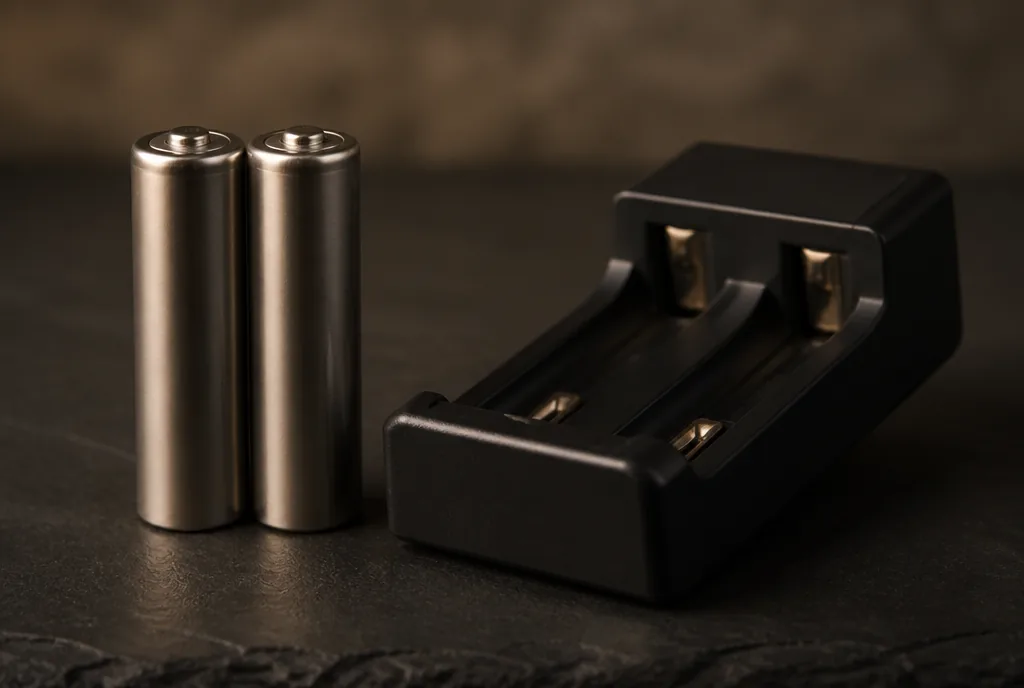
A 21700 battery is a cylindrical lithium-ion cell measuring 21 mm across and 70 mm long, the final zero simply describing the round shape. Its nominal voltage is 3.7 volts, and it reaches 4.2 volts fully charged. Everything you experience as runtime happens between those two numbers.
So the useful approach is to check three things in that order. Has your vaping changed, has the cell simply aged, or is it being asked for more than it was built to give? Each one has a different answer, and only the third costs money.
Telling a real loss of runtime from a false alarm
Before you blame the cell, rule out the explanations that have nothing to do with it. They account for a good share of the cases people bring into British vape shops, and they take minutes rather than money to check.
The first is a change in power. Moving from a tighter mouth to lung setup to a sub ohm one drains a cell far faster with nothing on screen to warn you, and fitting a fresh coil of a lower resistance does exactly the same thing without you touching a setting.
Cold weather is the second. Below ten degrees the voltage sags temporarily and the mod reports a low battery while the charge is still sitting there. The gauge recovers once the device is back at room temperature, which is why a winter commute can look alarming and mean nothing at all.
The third is the gauge itself. A mod estimates what is left from instantaneous voltage, not from a capacity measurement, so it is an informed guess rather than a reading. A cell that still shows three bars and then cuts out without warning is telling you its discharge curve has collapsed, not that the electronics have failed.
What actually ages a cell
Once the false alarms are out of the way, four factors explain genuine degradation, and they stack on top of one another. The first is unavoidable: every cell has a finite number of charge cycles, and once you are past it the loss becomes noticeable from one week to the next.
Repeated deep discharges come second. Emptying a cell until the mod cuts out wears it faster than topping up earlier, so recharging before the power visibly softens spreads the wear across many more cycles.
Third comes current. A cell asked for more than its continuous discharge rating gets hot, and that heat degrades the internal chemistry permanently. It is the most underestimated factor of the four, precisely because nothing on the screen ever reports it to you.
Heat from outside finishes the list. A mod left on a car dashboard in the sun suffers more in an afternoon than in a month of ordinary use, and keeping spare cells somewhere cool and dark measurably extends their working life.
Reading the figures on the wrap without guessing
Two values are printed on a cell: the continuous discharge rating, often shortened to CDR, and a pulse figure that only applies for very short bursts. Only the first describes what the cell will do all day, and the second is the one marketing prefers to print largest.
Here is the part British forums repeat for good reason. A printed wrap is not a reliable source, because rewrapped and relabelled cells circulate widely, and the number on the sleeve is sometimes an aspiration rather than a measurement. The authority is the cell manufacturer’s own datasheet for that exact model, and nothing else.
The same discipline applies at the other end of the circuit. The wattage window printed on the coil is the range that coil was designed for, and your device belongs inside it. We deliberately do not publish a figure that would supposedly suit your setup, because the only numbers that mean anything are the ones on your coil and in your cell maker’s documentation.
If those two documents do not agree with the way you like to vape, the answer is to change the hardware rather than to lean on the cell. Advice picked up on a forum, this article included, cannot stand in for either of them.
The signs that take a 21700 battery out of service
Some symptoms stop being about comfort. A cell that gets unusually hot in use or on charge, that shows any swelling of the body, or whose voltage collapses on the very first puff, comes out of service without debate and does not go back in.
The plastic wrap deserves the same attention. If it is split, pierced or peeling at the shoulder, the metal body is exposed, and simple contact with keys or coins in a pocket is enough to cause a short. A damaged wrap is either replaced properly or the cell is retired.
Carrying cells follows the same logic. A hard or silicone case stops the terminals meeting anything metal in a bag, and it costs a fraction of a replacement cell. It is the one accessory that genuinely matters if you carry loose cells at all, and the one most often skipped.
What to do with a cell at the end of its life
A used cell does not belong in household waste. In the United Kingdom, larger shops selling batteries are obliged to take them back, and household waste recycling centres accept them as well, so there is nearly always a collection point within reach.
On charging, an external charger is preferable to charging through the mod, which is better treated as an occasional stopgap than a routine. The subject deserves its own treatment, which is why we cover it separately in the guide to choosing a vape battery charger.
Finally, write the purchase date on the wrap in marker, or keep it in a note on your phone. It is the only reliable way of knowing whether a cell has genuinely done its time rather than guessing, and it settles most of the arguments you have with yourself about replacing it.
Frequently asked questions
Can the USB port on my mod replace an external charger?
It gets you out of trouble occasionally, but the heat produced during charging is not vented from inside the chassis. A dedicated charger has far more room around the cell and remains the better daily habit.
Does a 21700 fit a mod built for 18650 cells?
No, both the diameter and the length differ. The reverse is sometimes possible on a 21700 mod, using an adapter sleeve supplied by the manufacturer for that specific device.
What do IMR and Li-ion mean on the wrap?
IMR describes a lithium manganese chemistry with a reputation for stability and a generally higher discharge capability. Conventional lithium-ion cells tend to offer more cycles with a more modest discharge figure.
Should I check a build with an ohm meter on a mechanical mod?
Yes, since these devices have no electronic protection at all. Reading the resistance of the build before the first fire is the only way to catch a fault before it becomes a problem.
How do I replace a damaged wrap?
You need heat shrink tubing in the correct diameter and a gentle heat source such as a hot air gun. It takes a few minutes and saves discarding a cell that is otherwise perfectly sound.
What to watch on a 21700 battery day to day
The working life of a 21700 battery comes down to three things held steady over time: a discharge capability that genuinely matches what you ask of it, recharges started before the cell is flat, and a wrap in one piece. A quick look each time you swap cells is enough to spot the one that should leave the rotation.
If the runtime is still disappointing after all that, look sideways rather than at the cell. A coil past its best pulls harder for the same result, as our guide to coil life explains, and a poor contact can look exactly like a tired battery when it produces a no coil detected message. Once those are eliminated, what remains is cycles, and nobody escapes those.
Editorial content for adult readers only. Vaping products usually contain nicotine, a substance that causes addiction. Not for sale to under-18s in the United Kingdom. This article is not a buying recommendation.