Vape pen habits that keep leaks and burnt hits away
A light that changes colour without warning, a drop of e-liquid at the bottom of a pocket, a flavour that fades after a few days. The vape pen has a reputation as the simplest kit there is, with one button, one tank and one battery. That very simplicity is what leaves you stuck when something goes wrong, since there is no screen to explain the problem. The clues are there all the same, as long as you know where to look.
Using a vape pen without hassle, the essentials
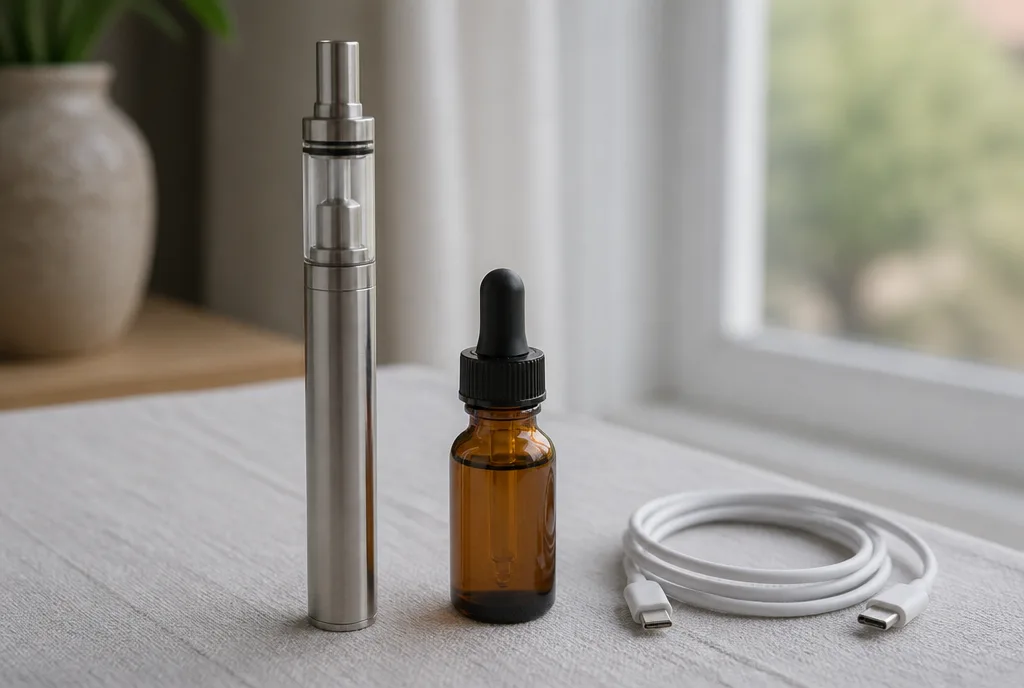
A vape pen is a cylindrical device around 2 cm across that brings together a battery, a tank and a coil. On an all-in-one (AIO) model, the tank sits inside the body of the device. On a classic pen kit, a tank screws onto a battery of the same diameter.
Almost every vape pen problem comes down to four areas, and each has its own habit:
- charging, which you read on the LED and manage with the right cable;
- filling, behind the vast majority of leaks;
- the coil, which explains flavour that fades or tastes burnt;
- travelling, in a pocket or on a plane, where a few rules apply.
With no screen, the pen talks to you through its light, its draw and the taste of the vapour. Learning to read those three signals heads off most unpleasant surprises.
Reading the LED and charging a vape pen
The LED is the only dashboard a pen has. Its colour and its flashes tell you the state of the battery, provided you know the code for your model, which is set out in its manual.
What the LED colour tells you
Codes vary from one manufacturer to the next, which is why the manual is worth keeping. Take the eGo AIO 2 as an example. According to the Joyetech product page, its LED runs through seven charge bands: red from 0 to 10%, purple from 10 to 25%, yellow from 25 to 40%, white from 40 to 55%, blue from 55 to 70%, cyan from 70 to 85% and green above 85%.
The useful reflex is to charge as soon as you see purple. A battery run right down cuts out at the least convenient moment, usually far from any cable.
Charging with the right cable
Most recent pens charge over USB-C, straight into the device. The eGo AIO 2 takes a 5 V, 1 A charge and fills up in about an hour and a half according to its maker. A computer or a mains adapter whose output matches the figure given in the manual does the job.
A few older or more powerful tube devices take a removable battery instead. That cell is then charged in an external charger, with the precautions covered in our piece on the vape battery charger.
Filling without leaks, two habits that matter
Leaking is the number one irritation with the pen format, and it usually starts at the moment you fill. Two habits are enough to make it disappear in most cases.
Never go past the maximum line
In the UK, the Tobacco and Related Products Regulations 2016 cap a refillable tank for nicotine e-liquid at 2 ml, and nicotine e-liquid itself at 20 mg/ml in bottles of no more than 10 ml. With a tank that small, the margin is thin. Most tanks carry a maximum fill line, and going past it leaves too little air for the pressure to balance when you refit the cap.
The surplus e-liquid then looks for a way out and finds it through the airflow holes. Filling slightly below the line, then screwing the cap back on without forcing it, cures a good share of leaks.
Keep the central tube dry
Down the middle of the tank runs the chimney that carries vapour up to the mouthpiece. E-liquid poured into it lands straight on the coil and either drips out of the bottom or comes back up as gurgling. Tilt the device slightly and let the e-liquid run down the inside wall.
If gurgling appears anyway, remove the mouthpiece, tap the pen gently over a tissue to clear the excess, then start again with a short puff.
When the flavour fades or tastes burnt
A pen offers little or no power adjustment, so the taste depends mainly on the coil and its condition. Three situations come up again and again, and each has its answer.
Flavour that dulls over several days points to a gunked coil. Very sweet e-liquids generally speed up that build-up on the cotton. The fix is a fresh coil, without waiting for the burnt taste.
A sudden burnt taste, just after a refill or a coil change, means dry cotton. Stop, let the e-liquid soak into the wick for a few minutes, then ease back in, as our guide to the dry hit explains.
Thin vapour with a decent taste often comes down to the airflow. On the eGo AIO 2, the airflow ring is fully open when the marks line up and at its tightest after a quarter turn. A draw closed too far on a thick e-liquid gives weak vapour, while one opened too wide dilutes the flavour.
Carrying a vape pen, in your pocket and on a plane
The pen format was designed to go everywhere with you. That convenience has a flip side, because a device slipped into a pocket or a bag has to put up with knocks, heat and changes in pressure.
In a pocket or a bag
Store the pen upright, mouthpiece at the top, rather than flat at the bottom of a bag. The e-liquid then stays at the base of the tank, away from the airflow holes. Avoid the glovebox in summer or a sunny windowsill too, as heat thins the e-liquid and encourages leaks.
On models that allow it, switch the device off before putting it away, so that nothing pressing on the button can fire it by accident. A spare battery, for its part, never travels loose among keys or coins.
On a plane
GOV.UK’s hand luggage guidance lists e-cigarettes as allowed in hand luggage and not allowed in hold luggage. The same page asks travellers to charge their electronic devices before they travel, and warns that a device which does not switch on when requested will not be allowed onto the aircraft. A flat vape pen at the security check could mean leaving it behind.
Flying has another practical consequence. Cabin pressure, lower than on the ground, can push e-liquid out of an overfilled tank. Travelling with a half-full tank limits that risk.
FAQ
A few questions that come up once the pen is in your hand, and that the sections above do not cover directly.
Does a vape pen fire with a button or on the draw?
Both exist. Most classic pens heat while you hold a button, whereas some newer models fire automatically when you inhale. The manual tells you which, and the activation type matters when you put the device in a pocket.
Can you leave a pen charging unattended?
It is best avoided. Unplugging the device once charging is complete and placing it on a hard surface, away from fabric, is the simplest precaution, as with any device that runs on a lithium battery.
Which e-liquid suits a pen best?
A pen with a tight draw generally works with thinner e-liquids, around 50% propylene glycol (PG). An e-liquid very high in vegetable glycerine (VG) moves more slowly through the cotton of a small coil and makes dry puffs more likely.
Why has my pen stopped switching on?
Check the charge first, then the contact between the coil and the battery, which e-liquid or dust can disrupt. If the device reports a missing coil, the steps are much the same as for the no coil detected message on a box mod.
Should you clean the tank of a pen?
A rinse in warm water at every coil change is enough, with the coil removed and the parts dried thoroughly before reassembly. On an all-in-one model, a damp paper towel passed through the tank takes the place of a full strip-down.
Vape pen care, the habits worth keeping
A watched LED, a tank filled below the line, a coil changed at the first sign of fatigue and a device stored upright, those four habits settle most of what goes wrong with a pen. The rest is in the manual, which sets out the LED code and the airflow adjustment for your model.
Once you have the hang of it, a vape pen becomes a device you can forget about, and the same attention to small signals applies to every piece of vaping kit, from pod to tank.
Related reading
Editorial content for adult readers only. Vaping products are not for sale to anyone under 18 in the UK, and nicotine is a highly addictive substance. This article is not a buying recommendation.